

San Francisco is an amazingly beautiful city, but it’s not without its problems. One of the most frustrating things is that many of these problems are self-inflicted. The city strangles itself with processes and bureaucracy that make it nearly impossible for anything to progress or change. For example, opening up a restaurant can be prohibitively expensive, as Jason Yu found out when he spent over $200,000 and 16 months battling the city’s red tape trying to open an ice cream shop (he called it quits and now has a debt to pay off). The city is dealing with a massive housing crisis, but by making housing production subject to endless public comment that delays construction and handicaps final designs, San Francisco is nowhere close to building the number of units needed for affordability.
So when I learned about Ludwig von Mises’s 1944 book Bureaucracy, I was curious to see if he could offer a solution to the misery of endless process and inefficiency in local government. I had doubts though. Ludwig von Mises was an Austrian libertarian economist with a hard-on for the free market. To be honest, any time I hear the word “libertarian”, I immediately think of people who think driver’s licenses are oppression. But I was curious to hear his thoughts on the differences between private enterprise and public institutions and wanted to give the book a shot.
And to be honest, the beginning was rough. When I read the word “opprobrious” on the first page, I had to step outside my apartment and go for a walk, unsure if I was ready to subject myself to an SAT Vocabulary Test word salad. Mises spends a majority of the beginning of the book railing against the New Deal, which in my opinion, wasn’t a bad deal. But as I got further along, I finally got to the meat of the book.
The profit motive is precisely the factor that forces the businessman to provide in the most efficient way those commodities the consumer want to use
Mises’s main thesis is that private enterprise is more efficient than public services because of the presence of the profit motive. Increasing revenue while reducing costs provides businesses a clear metric to measure success, those that fail to do so will go out of business. Mises argues that public services have no such measures and that trying to apply traditional tools of management from the private sector to the public will fail. When it comes to a fire station or the FBI, how would you measure efficiency?
A private enterprise is doomed if its operation brings losses only and no way can be ound to remedy this situation…. It is different with a public enterprise. Here the appearance of the deficit is not considered proof of failure.
While Mises prefers the structure of the private enterprise, he argues that the bureaucratic methods of the public sphere are actually needed. A business owner can give subordinates a free hand to operate because there are clear signals from the market whether actions were successful, encouraging innovative solutions to increase profit. But without the clear signal of the market, the public sector can’t afford this freedom. Instead, they rely on centralizing administration and restricting the freedom of department managers in order to prevent excesses and the abuse of power.
So what is the solution to government inefficiency and bureaucracy? Mises offers no suggestions. In fact, I don’t think he even cares. He’s a libertarian economist, the perfect world for him is one where businesses can be mostly free of government intervention. The biggest thing he stresses in his book is explaining why government shouldn’t meddle in the affairs of private business: because it doesn’t have the tools to measure efficiency and success easily.
Reading Bureaucracy, I think Mises is right about his point on why business is generally more efficient than government but was disappointed he didn’t offer any solutions. I think solutions are out there, but implementing them is easier said than done. To generalize his point, the reason why private enterprise is more efficient is because there is a clear and transparent metric (profit). Failing to hit that metric will cause the business to fail. Fear of avoiding that failure (and greed in growing the business) is what keeps people accountable. This becomes very clear when comparing small startups and businesses to larger enterprises. Employees at small businesses feel much more ownership and pressure to ensure the company is profitable. Employees at larger companies generally do not feel that same pressure, since their impact is smaller and the company can feel too big to fail.
When thinking about how the public sector could be more efficient, I think two things are needed: metrics and accountability. These are two pieces that are inherent in the profit motive that drives companies, but missing in the way government operates.
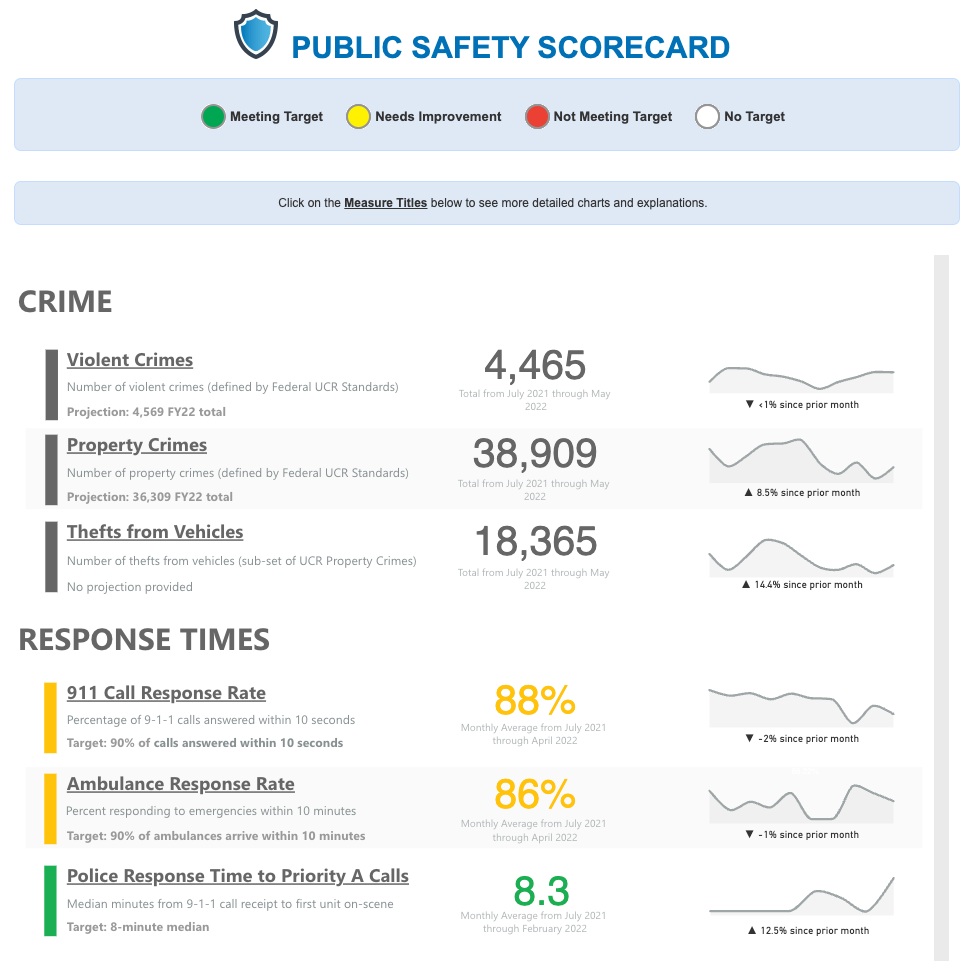
Let’s start off with metrics. I was surprised to learn that San Francisco actually does keep track of metrics on its Performance Scorecards page. The city tracks performance across different vectors like Transportation, Public Safety, Environment, and more. But does the city keep track of the right metrics? I’m not so sure. With pages and pages of scorecards, it seems like the city does keep track of a lot, but I’m curious what the highest priority metric is. In private enterprise, it’s easy: profit. In the public sector, it’s a little trickier. What would be the right goals for San Francisco (or any city)? How could we keep score to know that our city is moving in the right direction?
But it’s not enough to just measure performance, people need to be held accountable for these metrics. In private enterprise, it can be clear when decisions were unprofitable, which can be used as learning lessons for future decisions or can lead to consequences for poor performers. In the public sector, accountability is a little less clear. The most direct way to hold those in office accountable is through elections. But the public generally doesn’t have the access (or time) to know which decisions led to which outcomes, and elections are generally driven by strong narratives, not by performance data. Appointed government officials are even less accountable, in positions where relationships can matter more than outcomes.
In my ideal world, the city of San Francisco would publicize a quarterly review to see the direction city metrics (citizen happiness, transportation efficiency, etc.) have moved. The biggest blocker to this world isn’t the difficulty in selecting and measuring the right metrics, it’s having the political willpower to enforce accountability on public officials. But if you were a public official, would you want to be held accountable? How did you feel being graded in college or before a performance review at work? No one really likes being held accountable, and if you could avoid it you probably would. But that, along with tracking the right metrics is the piece I believe is missing to unlocking a more efficient public sector.
Ludwig von Mises correctly identifies that the profit motive is what makes private enterprises more efficient. It’s something that is much easier to calculate and understand. But he lacks the interest in thinking about how lessons regarding the advantages of the profit motive can be applied to the public sector. I hope we can one day build political structures that reward innovation and give citizens a clear picture of what direction their city and country are moving. But in the meantime, identifying where clear metrics and accountability are missing is a start.
Great read! it’s very classic libertarianism to just call out where government fails but to not offer solutions lol
I think you’d be interested in public choice field of Econ where economists (eg Nobel prize winner James Buchanan) assume that government officials are motivated by profit, and they draw insights from that assumption. They’re kind of like the ideological children of Hayek in that way